
Running Club Marketing Ideas: How to Ride the Run Club Boom Instead of Waiting for Word of Mouth
Practical running club marketing ideas for organizers: turn the run club boom into real members with word of mouth, local store partnerships, and events.
Most running clubs grow by accident.
A few friends invite a few friends. Someone brings a coworker. The Sunday run creeps from six people to eleven, and then it sits there for a year. The club is not failing. It is just plateaued at the size of the founder's social circle, waiting for word of mouth to do a job that word of mouth was never organized to do.
Here is the frustrating part. Right now is the best moment in years to grow a running club, and most organizers are not set up to catch the wave. Group running is having a genuine cultural moment heading into 2026, and the clubs that treat recruitment as a repeatable system are the ones pulling ahead. The ones hoping members will just appear are watching newcomers walk right past them to a club that made itself easy to find and easy to join.
This post is for the person actually running the club. Not the individual runner chasing a faster 10K, the founder or admin juggling the roster, the events, and the growth all at once. Marketing is one of those jobs, whether you asked for it or not. Let us make it a system instead of a hope.
The run club boom is real, but it will not find your club for you
The demand is not theoretical. Global run club memberships surged 59 percent in 2024, according to CEP Running's 2026 analysis of run club culture. In the United States, the number of running clubs has climbed roughly 25 percent over the past five years, per Accio's 2025 running club trends report. More people are looking for a club to join right now than at almost any point in the last decade.
So why do so many clubs still feel stuck?
Because the boom raises the tide, but it does not steer anyone to your specific Tuesday night run. The trap most clubs fall into is relying purely on accidental word of mouth. That works beautifully to get from three members to fifteen, and then it quietly stops, because you have run out of friends of friends. The wider demand is out there, but nothing in your setup is reaching for it.
The reframe is simple. Marketing your club is an operational responsibility you own, right alongside planning routes and keeping the roster current. It does not have to be loud or salesy. It has to be intentional and repeatable. The rest of this post is the mix that works, one layer at a time.
Turn word of mouth from luck into a system
Word of mouth is the single strongest channel in running. The run club world is one of the most referral-driven communities anywhere, the kind where one person's good experience spreads through a friend group fast. So the goal is not to replace word of mouth. It is to stop leaving it to chance.
The difference between accidental and systemized word of mouth is whether you create the moment to share, or just wait for it.
A few ways organizers prompt referrals on purpose:
- Give every member an invite they can send in one tap. A shareable club page with your when, where, and pace beats "text me and I'll explain how it works." If a member has to describe your club from memory, most will not bother.
- Run a bring a friend day and actually name it. People invite others when they have permission and an occasion. A designated newcomer-friendly run gives a hesitant member the nudge to say "come with me this week."
- Make the newcomer experience worth talking about. A first timer who gets greeted by name, matched to the right pace, and told exactly where to stand goes home and tells people. A first timer who stood awkwardly at the back and left early tells no one.
Systemized word of mouth is not a gimmick. It is just removing the friction between a member's goodwill and the next person walking up to the start line.
Partner with the local running ecosystem
Your club does not exist in a vacuum. It exists in a neighborhood full of businesses that want exactly what you have, foot traffic and a reason for people to gather.
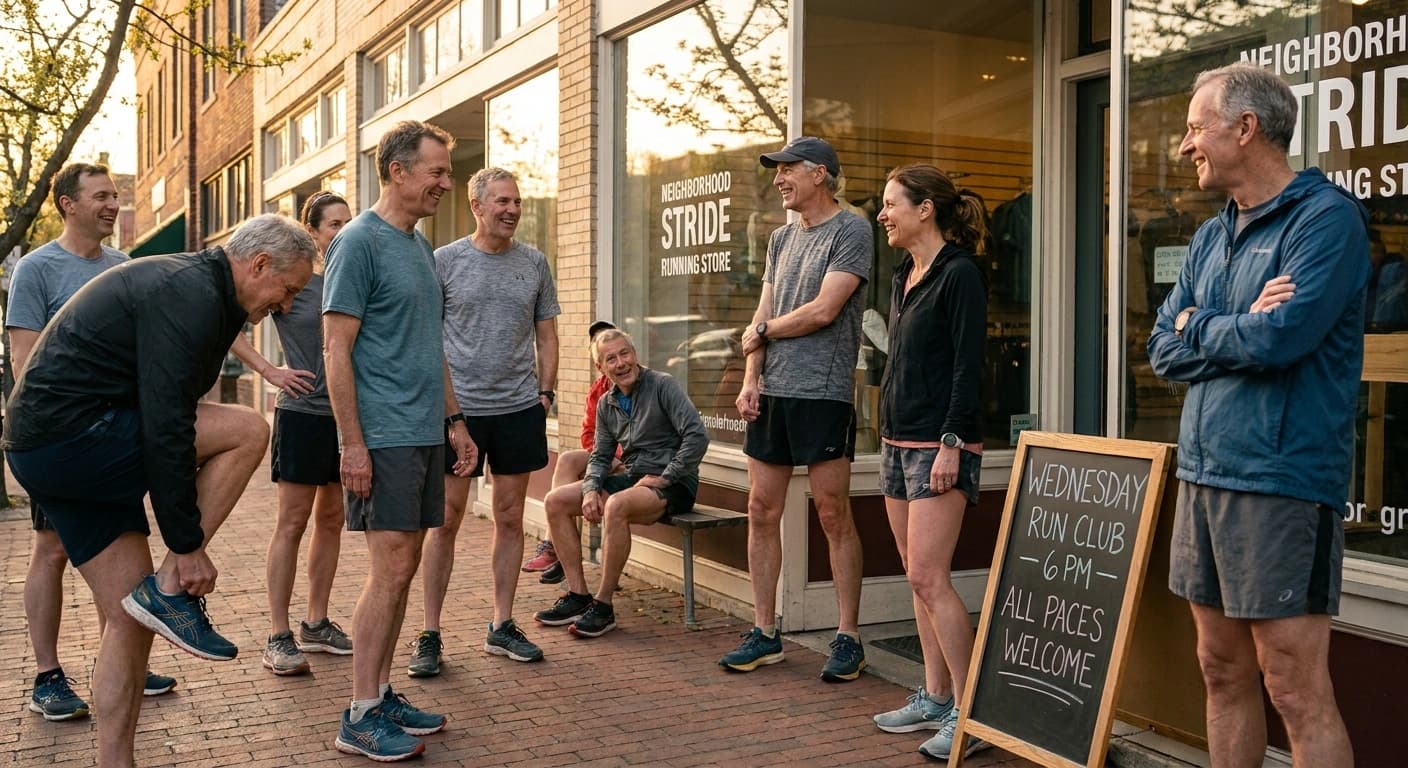
Local running specialty stores are the obvious first call. A store wants runners in the door, and you want to reach runners who are already in the buying-and-belonging mindset. A weekly run that starts or ends at the shop is a fair trade. They get regular visits from your members, and you get introduced to every runner who walks in asking "are there any good clubs around here?" That is a warm handoff you cannot buy.
Coffee shops and breweries work the same way. A cafe that hosts your post-run coffee gets a standing crowd on a slow morning. You get a comfortable, findable home base and a reason for the social half of the club to stick around, which is often where the real retention happens.
You can also cross promote with complementary local groups, a strength class, a run-focused physio, a track night, without diluting your running focus. The rule of thumb: partner with businesses and groups that serve runners, not ones that pull you away from being a running club. Keep the running identity sharp. Borrow the audience, not the mission.
Use beginner friendly events as your on ramp
The scariest thing about joining a run club is not the running. It is the fear of being the slowest, the newest, the one who does not know anyone. Your marketing has to answer that fear before someone shows up, or they never will.
Beginner friendly events are how you lower that barrier on purpose. A no-pressure, all-paces-welcome run tells a nervous newcomer the one thing they need to hear: you will not be left behind and you will not be judged. That single promise converts more hesitant runners than any clever caption.
Themed and social runs do similar work from a different angle. A sunset run, a coffee run, a costume run around a holiday, a route that ends somewhere fun, all of it gives a curious outsider a low-commitment reason to try you once. Nobody feels like they signed up for a training program. They just came to a thing that looked friendly.
The mindset shift is the important part. That first run is a marketing event, not just a workout. Treat it like a front door. Greet people, explain how it works before you start, and make sure the newest person there has the best time. Do that consistently and your events become the most reliable recruiting tool you own.
Be findable when a new runner goes looking
Here is a moment that happens every day in your city. Someone new to the area, or new to running, pulls out their phone and searches for a running club near them. In that moment, they will find a club and show up to it. The only question is whether the club they find is yours.
Being findable is not about being loud. It is about being clear and current. A new runner needs to answer five questions in about ten seconds: where do you meet, when, what pace, who is it for, and how do I just show up. If your club page answers those instantly, you win the newcomer. If they have to dig through a buried Instagram post from four months ago or request access to a spreadsheet, you lose them to a club that made it obvious.
This is also why local discovery matters so much for run clubs specifically. Nobody joins a running club two states away. Club discovery is inherently a local search, so the clubs that keep a clear, current, easy-to-find home page are the ones that quietly absorb the steady trickle of "is there a run club near me" searches happening in their own neighborhood.
A quick contrast worth naming: a Strava club is a fine activity feed for members you already have, but it is not a recruiting engine or a findable front door for someone who has never heard of you. It shows runs after the fact. It does not answer "how do I join you this Tuesday" to a stranger. Different tool, different job.
Stop marketing across six disconnected tools
Now the honest problem underneath all of this. You can do every idea above and still bleed effort, because the typical club runs its marketing across a pile of tools that do not talk to each other.
The flyer points to an Instagram account. The Instagram bio points to a group chat. The group chat points to a Google Form. The form feeds a spreadsheet nobody updates. The newsletter goes out from a fifth tool that has half the list. Every one of those handoffs is a place a potential member gets lost, and every one of them is more work for you, the founder who is already the integration layer holding it all together.
The fix is not another tactic. It is a single home for the club. When your page, your events, your RSVPs, and your roster all live in one place, every marketing touch you make can point to the same front door. The store partnership, the bring a friend day, the local search, the newcomer's first tap, all of it lands somewhere consistent, current, and built for growing your club instead of scattered across six apps you have to babysit.
That is exactly why we built RunLink. One app to run and grow your club, the page, the events with routes, the RSVPs, the messaging, and the roster together, so the marketing you already do actually converts instead of leaking out the seams.
The run club boom will not last forever, and it will not knock on your door. But for the clubs willing to market on purpose, this is the best recruiting window in years. Build the system now.
Ready to give your club one findable home instead of six scattered tools? Set up your club for free at RunLink.
Related Posts
Halloween Run Club Event: Plan a Costume Run That Recruits
A Halloween run club event is the easiest bring-a-friend run of the year. How organizers set the time, route and costume rules, then follow up after it.
Running Club New Member Onboarding: How to Keep the Newcomers the Boom Is Sending You
Running club new member onboarding is where the run club boom is won or lost. Here is a simple first-30-days plan to turn a one-time visitor into a regular.