
Running Club RSVP System: Stop Chasing Headcounts Before Every Group Run
A real running club RSVP system replaces the WhatsApp poll, the Google Form, the Strava event, and the spreadsheet. Here is what it should actually do.
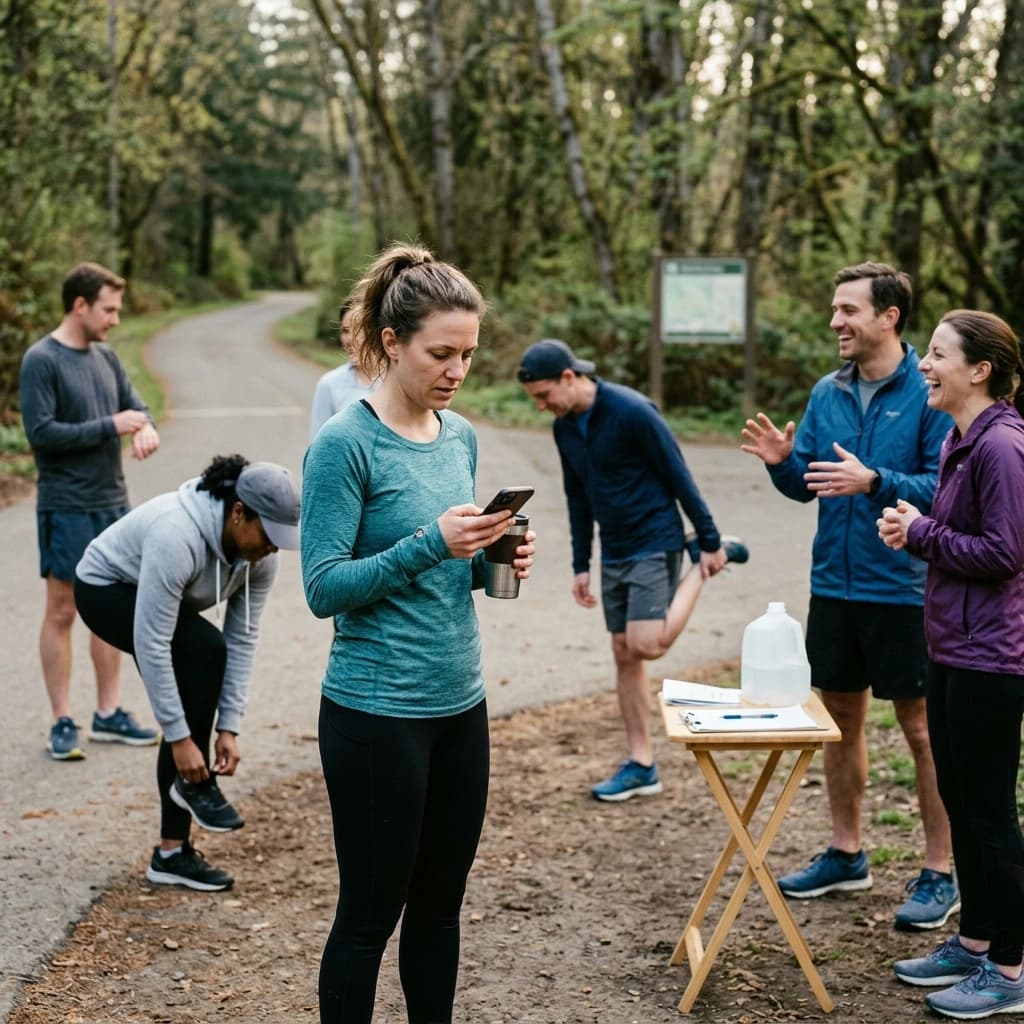
It is 6:48 on a Saturday morning. Your club meets at the park at seven. You are standing near the trailhead with a coffee in one hand, your phone in the other, and a question you cannot answer with any confidence.
How many people are actually coming.
You opened the Strava event last night and it said sixteen interested. Your WhatsApp poll said twenty two. The Google Form you sent for the brunch afterward got eight responses. Three people DMed you on Instagram to ask if the run was still on after yesterday's rain forecast. Two regulars texted you directly because they always text you directly. Your pace leaders are pinging you in the group chat asking how many to expect in each group.
You sip the coffee. You guess twelve. Twenty seven show up. The other pace leader brought twelve gels for an eight person group and now you have an awkward gel deficit, two unhappy newcomers who never got the route message, and a sponsor at the post-run coffee shop who reserved seats for ten and is staring at a crowd of twenty seven.
This is what running a running club looks like in 2026 without a real RSVP system. Not broken in any single place, but broken across every place.
The RSVP is not a polite formality, it is the operational anchor
Most club founders treat the RSVP as a courtesy. A nice-to-have for planning. It is much more than that, and the clubs that figure this out tend to be the ones that grow past the messy middle.
Your RSVP is the upstream signal that drives every other decision in the next twelve hours:
- How many pace groups to staff and who leads each one
- How many gels, gummies, or hydration mixes to bring
- Which route to call, the long one or the short one, based on the mix of people coming
- Whether to book the back room at the coffee shop or just grab a normal table
- Whether the new member coordinator needs to show up early
- Whether to send a "we are still on" message if weather is borderline
- Who to follow up with afterward, and who to gently re-engage if they bailed
If the RSVP signal is fragmented across five tools, every one of those decisions is a guess. And every wrong guess costs you something, a no-show rate that creeps up, a sponsor who stops returning calls, a new member who never comes back because no one knew to look out for them.
The fix is not "be more organized about WhatsApp polls". The fix is admitting that polls in a chat app are not an RSVP system, and you need an actual one.
Why the typical RSVP stack falls apart
Walk into almost any small to medium running club and you will find some version of this:
- Strava event for the activity feed and route preview
- WhatsApp or Discord poll for the unofficial headcount
- Google Form when there is something extra to coordinate, like brunch or a long run with paid coffee
- Eventbrite for the few events that need actual ticketing
- Mailchimp so people who do not check the chat app daily still hear about the run
- A spreadsheet that the founder updates by hand on Friday night to reconcile it all
Each tool is fine in isolation. Strapped together, they cause exactly the situation that ate your Saturday morning. Members RSVP in whichever tool they happened to be in when they remembered. Some people RSVP in two places. Some people RSVP nowhere. The founder is the integration layer, manually merging the signal at 11 PM on Friday and crossing their fingers.
Here is what actually goes wrong, in order of how often it bites:
Members do not know which tool is the "real" RSVP. If you have ever sent a "please RSVP on Strava this time so we can plan" message and then watched half the club RSVP on the WhatsApp poll anyway, you know exactly what this feels like. People will not learn a new ritual for a side project. They will use whatever tool is in front of them when the thought hits.
Some tools do not capture pace or distance preference. A WhatsApp yes does not tell you whether the person wants the 5K loop or the 8 mile route. So even when you do get a headcount, you do not know how to staff pace groups around it.
No-show rates climb when there is no reminder. Most ad hoc RSVP setups do not auto-remind. People say yes on Monday, life happens by Saturday, and you get the Saturday morning gel deficit.
The roster never updates from the RSVPs. The fact that someone showed up to four runs in a row is the single best retention signal you have. Most clubs never capture it because the RSVPs and the roster live in different places and nobody is doing the bookkeeping.
Newcomers fall through the cracks. A new runner who shows up because a friend forwarded the WhatsApp link has no profile, no waiver, no contact info, no pace info. Three hours later they have done their first group run and you have no way to follow up with them.
What a real running club RSVP system should do
A real RSVP system for a running club is not a generic event tool with running stuck on top. It needs to handle the actual cadence and texture of how a club operates week to week. At minimum, it should do these things:
Live in the same app as the rest of the club. The single biggest determinant of whether members RSVP at all is friction. If the RSVP is one tap inside the same app where they see the route, the meet time, and the other people coming, RSVP rates go up sharply. If it is a link to an external form, RSVP rates collapse. That is the model behind RunLink's event tools for club organizers: the RSVP sits on the event, next to the route and the meeting spot.
Capture pace group and route choice at RSVP time. Not "yes I am coming". "Yes, I am coming, I want the 8 mile route, I will run with the 9:30 pace group". That data is what makes Saturday morning sane instead of chaotic. It is also what gives pace leaders some authority over their group instead of just guessing.
Auto-send a reminder the night before and the morning of. Two reminders, on a schedule, in the same app. The night-before reminder gives lapsing RSVPs a chance to drop out cleanly. The morning-of reminder converts the "I forgot to RSVP" crowd into a yes before they roll over.
Show pace leaders the headcount and the list of who is coming. Not a number floating in chat. A real list, by pace group, with names, with a flag on first-timers, so the pace leader can call out new members by name before the run starts. That single behavior, by itself, is one of the strongest retention levers a club has.
Capture every RSVP as a roster signal. When a member RSVPs and shows up, that is attendance data that should automatically feed back into the club roster. After three months you should be able to see who has shown up consistently, who is trending down, and who needs a "we missed you" message. Without this, retention is invisible until it is too late.
Make it possible to limit numbers when needed. Most group runs are open. But trail runs with a fragile permit, post-run dinners at a small restaurant, ladies-only training runs, ambassador-only socials, those need a cap. A real RSVP system has caps, waitlists, and the ability to gate by membership tier.
Capture a waiver from new attendees, automatically. If a non-member RSVPs, the system should prompt for a waiver before the RSVP is confirmed. The single biggest legal liability for a club is the new runner who shows up with no waiver on file. Stop relying on the run leader to remember to chase a signature in the parking lot.
This is not a wish list, it is the minimum bar. Anything less and you are still doing manual reconciliation on Friday nights.
Tools that do parts of this, and why parts is not enough
A handful of tools handle pieces of this competently:
- Strava clubs handles the activity feed beautifully and shows interest counts on events. It does not handle pace selection, waivers, capped events, or roster integration. Strava is a tracking app with a club layer bolted on, not a club operations platform.
- Heylo handles RSVPs and chat in one place, which is a real improvement. It is a generic group platform though, so pace groups, route choice, and waivers are not first-class concepts.
- Meetup handles RSVPs and caps, but its UX is dated and members hate using it. RSVP friction is the killer.
- Eventbrite handles tickets and caps, but it is heavyweight for a free weekly run, and you would never run your Tuesday social through it.
Any one of these gets you part of the way. None of them is what a real club needs as the spine of weekly operations. The reason the multi-tool stack persists is that no single generic tool is purpose-built for the way running clubs actually work.
That is the gap RunLink is built for. The RSVP, the route, the roster, and the club chat live in one app. Pace groups, scheduled reminders, waivers, and attendance history are not part of it today, so handle those the way the section below describes.
The before-and-after for the founder
Picture next Saturday with a real system in place.
It is Friday at 5 PM. You glance at the app on your phone. Twenty four people have RSVPed for tomorrow's 8 AM group run. Fourteen want the 8 mile route, ten want the 4 mile route. Three first-timers in the mix, all with waivers signed. Two of your three pace leaders are confirmed. The system pushed a reminder out an hour ago, and four more RSVPs trickled in after that.
Saturday morning, 6:45, you are at the trailhead with your coffee. Your phone is in your pocket. You already know what the morning looks like. The pace leaders have their lists. The new members are flagged. You walk over to each first-timer and greet them by name before the run starts. The post-run coffee shop got a heads-up the night before that there will be roughly twenty five people. There is no gel deficit.
You spend the morning being a club captain, not an integration layer.
Where to start, even before you change tools
You can move toward this whether or not you switch platforms today.
Pick one RSVP channel and call it the official one. Tell the club, repeatedly, that this is the only one that counts. Stop running parallel polls in the chat app. The pain of pruning your stack is real, but it is much smaller than the pain of running five tools forever.
Capture pace and route at RSVP time, even if you have to do it with a clunky Google Form for now. The data is what matters.
Schedule a reminder you can actually rely on. Even a calendar event with a notification you forward to the group chat the night before is better than nothing.
Start tracking attendance from your RSVP data, somewhere. A simple spreadsheet that you update weekly is enough to start seeing retention patterns by month three.
Build a habit of capturing waivers from non-members before the run, not in the parking lot.
Those four changes alone, even with messy tools, will move the needle. They also set you up to actually feel the benefit of a real system when you adopt one.
The bigger pattern
The RSVP problem is one example of a larger truth about club operations. Almost every recurring headache a founder deals with, from roster sprawl to comms fragmentation to event chaos to dues collection, has the same root cause. A bunch of generic tools were stitched together because no single tool was built for how running clubs actually work. The founder pays for the missing integration with their Saturday morning, their Sunday evening, and eventually their motivation to keep doing this at all.
A purpose-built platform for running clubs is not a luxury. For a club that wants to grow past twenty active members without burning out the founder, it is the operational unlock.
If you are ready to consolidate, set up your club on RunLink for free and run next weekend's group run through a real RSVP flow. You can keep your existing channels live during the transition, and retire the WhatsApp poll once members are used to RSVPing on the event.
Stop chasing headcounts. Build the system once and spend Saturday mornings being a captain.
Run your club in one app
RunLink gives a running club a public club page, events with a mapped route and RSVPs, a roster with roles, and club chat in one place. The iOS app is free to download.
Related Posts
Running Club Attendance Tracker: Why You Need One the Moment Your Club Crosses 25 Members
A running club attendance tracker stops the headcount guesswork, reveals who is drifting, and turns Saturday mornings into data your club can actually use.
Running Club Communication Platform: Why Five Group Chats Are Quietly Breaking Your Club
A running club communication platform replaces the WhatsApp, Discord, and GroupMe sprawl with one channel your members actually read. Here is what it needs to do.
How to Consolidate Your Running Club Tools (Without Losing What Works)
Learn how to consolidate running club tools from a sprawl of eight apps into one stack, with a simple audit, a keep-merge-kill sort, and a safe migration plan.