
How to Get Sponsors for Your Running Club
Brands are chasing run clubs in 2026. Here is how to get sponsors for your running club, what to ask for, and how to keep it good for members.
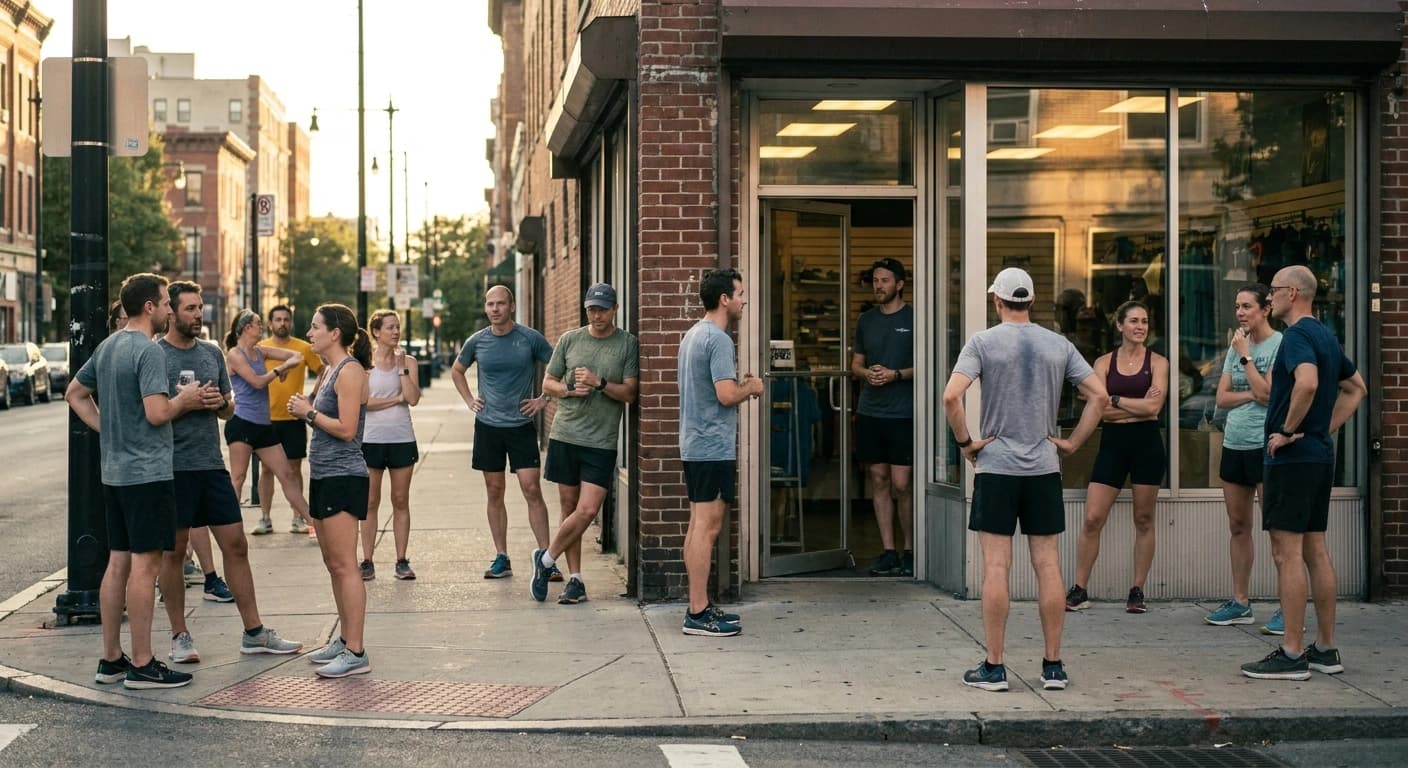
You get sponsors for your running club by proving repeat attendance, not reach. The first conversation should be with the running store two miles away, not a national brand's marketing inbox, and you should walk in with real numbers on who shows up and how often. Ask for something your members can use before you ask for money.
Most club organizers do the opposite. They open with a follower count, attach a sponsorship tier PDF they downloaded from a race website, and email a brand that has never heard of their city. That pitch fails because it is selling the wrong asset. A club's real asset is documented proof that a specific kind of person, in a specific place, keeps coming back. Instagram followers are cheap. Forty people on a start line every Wednesday for six months is not.
This one is worth getting right, because there is real money in the space now. If you have already done the hard work of growing your club, sponsorship is the part that comes after, and most organizers are unprepared for it.
What do sponsors actually want from a run club?
Not impressions. Sponsors want three things a club can uniquely deliver.
Repeat, in-person contact with people who buy running gear. A weekly run with 40 people is roughly 2,000 in-person contacts a year. That is simple arithmetic rather than a study, but it reframes the pitch. You are not selling one event. You are selling a standing appointment with a room full of buyers.
Trust transfer. When a club leader says a shoe worked for them, it lands differently than a paid ad. That is exactly why brands want in, and it is also why the relationship needs guardrails, which we get to below.
Product on feet and honest feedback. Shoe, nutrition and recovery brands want people actually testing their stuff and saying what they think. Modern Retail reported in January 2024 that an insole brand sponsoring club runs saw roughly 20 to 30 percent of members buy a pair after an event, across clubs ranging from 8 to 80 people. That figure is a few years old now and comes from one brand, so treat it as a signal rather than a benchmark, but it explains the appetite.
The scale of that appetite has grown fast. Endurance Sportswire reported on June 29, 2026 that Diplo's Run Club named a seven-partner sponsor roster for its 2026-27 season, with Altra as official running shoe alongside Barry's, WHOOP, Kane, Crewfare, Bilt and Beach Juice, activating across eight host cities. That program reported more than 100,000 participants across the prior season and expects more than 8,000 at its Denver opener.
You are not that. But the same money flows downhill. WWD's footwear coverage described Renegade Running in Oakland drawing roughly 80 to 100 people to track nights with financial and product support from Asics, On, Hoka and Nike. That is a local club, not a touring festival.
Why should you start with a local running store, not a national brand?
Because the store has a budget line for community and a person whose job includes local partnerships. A national brand has neither for a club of 40.
The independent running store is the most underused partner in the sport. Walk in on a Tuesday afternoon, ask who handles community events, and you are usually talking to a decision maker inside ten minutes. Compare that to twelve unanswered emails to a brand's regional marketing address.
What a store can realistically offer:
- A start and finish location, which solves your restroom and bag-drop problem in one move
- A standing member discount
- Gait analysis or shoe-demo nights
- Coffee, or a tab at the bar next door after a Saturday long run
- Their email list and window space, which is local reach you cannot buy
What the store wants back is not complicated. They want bodies in the shop on a slow weeknight, and they want a reason for your members to buy locally instead of ordering online at midnight. If your club delivers that reliably, the relationship renews itself without a negotiation.
A working store partnership is also your proof of concept. A brand rep asking whether your club is legitimate is easy to answer when a retailer they already sell to will vouch for you.
What numbers does a club need before it asks?
This is where most clubs stall, and it is worth being blunt about why. The numbers a sponsor cares about are not the ones organizers track.
Have these four ready:
- Average attendance over the last 8 to 12 weeks. Not your best night. The average, including the rainy ones. Consistency is the product.
- Repeat rate. How many distinct people came three or more times last quarter. This is the single most persuasive number you own, because it separates a club from a popular one-off event.
- Active roster versus total roster. Two hundred people in a group chat and 25 who run is a different business than 60 people where 45 show up. Say which you are.
- New members per month, and roughly where they live or work. Geography matters enormously to a retailer deciding whether your runners are near their door.
Here is the honest problem. Most clubs cannot produce a single one of those numbers, because attendance lives in a group chat, RSVPs live in a form nobody exports, and the headcount is whatever someone shouted at the trailhead. When the sponsorship conversation finally comes, the organizer guesses, and a guess sounds like a guess.
This is also where a Strava club stops being enough. Strava shows activity, which is people logging runs wherever they happen to be. It does not show attendance, which is people showing up to your event at your time in your place. Those are different facts, and only one of them is what a sponsor is buying.
The fix is unglamorous: keep the roster, the RSVPs and the attendance history in one place from now on. Every week you run without recording it is a week of proof you cannot get back.
How should a club structure the deal so members do not feel sold to?
Ask for member value first and visibility second. That single ordering choice protects everything else.
A sponsorship that gives your members a 15 percent discount and a free gait analysis night feels like a perk the club earned. A sponsorship that gives the club a banner and the sponsor a five-minute pitch at the start line feels like an ad your members did not sign up for. Same money, opposite outcome.
A few rules that hold up:
- One sponsor moment per run. A logo at the start, or a product table at the finish. Not both, not a gauntlet.
- Put it in writing, even one page. What the club delivers, what the sponsor delivers, how long it runs, and how either side ends it. This is not corporate overhead. It is what stops a vague favor from quietly becoming an obligation.
- Never sell or hand over the member list. Sponsor communication goes out through the club, on the club's terms, in the club's voice. This is the line that protects the trust the sponsor is paying for in the first place.
- Name an owner who is not you. If every deliverable lands on the founder who already does everything, the sponsorship becomes the reason the founder quits.
Club leaders have said publicly, in the WWD coverage among other places, that they are wary of brands trying to own a community they did not build. That wariness is correct and you should carry it into the room. The club existed before the sponsor and should be structured to outlast them.
What can go wrong with running club sponsorship?
Four failure modes show up repeatedly.
The run stops being the point. Once the calendar is organized around activations, members feel it immediately. Attendance drops in a way that is slow and hard to attribute until it is bad.
Exclusivity clauses that cost you the partnership you needed. A brand offering product may ask to be your only footwear partner. That can quietly block the local store relationship that was actually doing the work. Read the exclusivity language before the free shoes make you agreeable.
One-off drops that leave nothing behind. A brand shows up, hands out samples, gets photos, leaves. If you can, trade a smaller ask for a longer term.
Volunteer burnout. Sponsor deliverables are real work. Content, photos, reporting, logistics. If that lands on the same person handling the route, the roster and the group chat, the club pays for the sponsorship in the currency it can least afford.
Frequently asked questions
How big does a running club need to be to get a sponsor? Smaller than most organizers assume. Consistency beats size. A club reliably putting 25 people on a start line every week is a more attractive partner than one that drew 200 once.
Should a club charge dues and take sponsorship? Yes. They solve different problems. Dues fund the predictable operating costs and signal member commitment. Sponsorship funds the extras and the perks. If you have not sorted out dues yet, do that first, because a club that cannot fund its own basics is not ready to manage a partner.
What should a first sponsorship ask look like? One page. One specific ask. Real attendance numbers from the last quarter. Skip the tiered gold, silver and bronze structure entirely, because it signals that you copied it from a race and have no idea what you are worth.
Do sponsors want social posts or in-person presence? Increasingly in-person. Reach is cheap and everyone has learned to discount it. Being in the room with runners who came back on purpose is not something a brand can buy anywhere else.
Start recording the proof now
Sponsorship is not a growth strategy. It is what becomes available once your club is already working, and the clubs that get good deals are the ones that can document what is working.
If your roster, RSVPs and attendance history are scattered across a group chat, a spreadsheet and a form, that documentation does not exist yet. RunLink puts them in one place so the numbers a sponsor asks for are already there when the conversation happens. It is free to set up your club at runlink.app, and the app is on the iOS App Store now.
Set it up this week. In three months you will have the attendance history to walk into that store with something real.
Related Posts
Running Specialty Store Partnership: How Clubs Do It Right
A running specialty store partnership can give your club a home base, gear nights and new members. Here is what the store wants and what to put in writing.
Beginner Friendly Run Club Events That Actually Work
Beginner friendly run club events only work if nobody gets dropped. Here is how to design a first club run that a nervous new runner actually comes back from.