
Post-Run Social Ideas That Turn First-Timers Into Regulars
Post-run social ideas for running clubs: where to meet after the run, who should host it, and how to make first-timers stay long enough to come back.
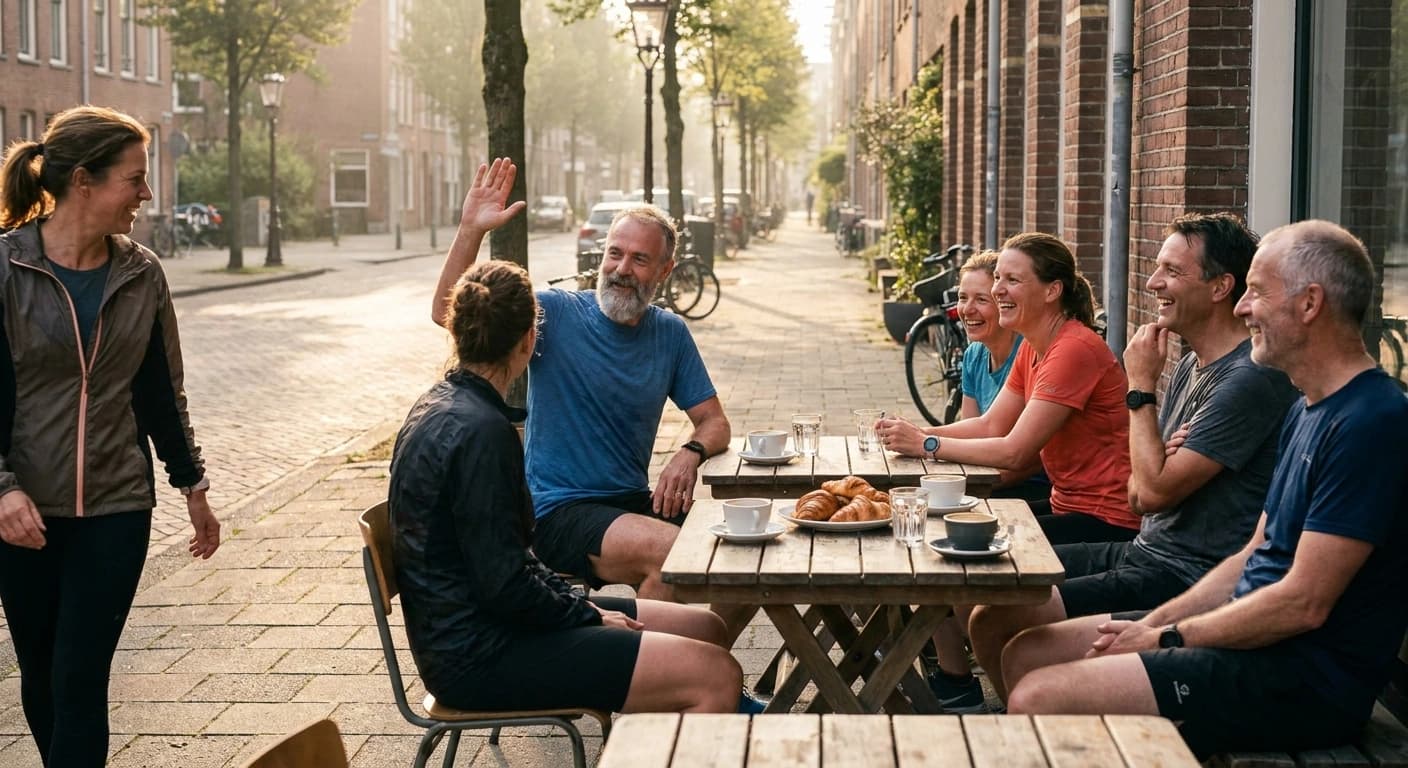
A post-run social is the short, repeatable hang right after your group run: coffee, breakfast, a patio table. It is the one moment of the week when a first-timer actually meets people, and meeting people is what brings them back. Most clubs plan the route carefully and leave the twenty minutes after it to chance.
That is backwards. Pace splits a group the moment the run starts, and the newcomer often runs the last mile next to nobody. The social is the only part of the morning where everyone is standing in the same place at the same time.
If your club is working on recruiting and keeping members, the post-run social is the cheapest lever you have. It needs no budget, no sponsor and no new event. It needs a few decisions you make on purpose instead of by accident.
What is a post-run social, and why does it matter more than the route?
Think about what a first-timer actually experiences. They found you online, worked up the nerve to show up, ran a route they did not know with people they had never met, and probably finished somewhere in the back half. If everyone scatters to their cars at the finish, that is the whole memory: a run they could have done alone.
Now picture the other version. They finish, someone says "we're going to the coffee place on the corner, come with us," and for twenty minutes they are sitting at a table learning names. Next week, they are not a stranger anymore. They are coming back to see people.
The route is the reason the club exists. The social is the reason a person stays in it. Treat it as part of the event, not an optional afterthought, and plan it with the same care you give the route.
Where should a running club go after the run?
Do not start with a list of venues. Start with criteria, because the right spot in your town is the one that fits these, not the one with the best pastries.
- Walkable from the finish. If people have to drive somewhere, half of them will just drive home. The best spot is close enough that the group walks there together, still talking.
- Tolerant of a sweaty crowd. Some places do not love twenty damp runners arriving at once. Pick one that is relaxed about it, ideally with outdoor seating.
- Open when you finish. An early Saturday run needs a place that is open and staffed at 7:30, not one that opens at 9.
- Able to handle a rush. A single register and one barista will create a fifteen minute line. That line is where people give up and leave.
- A cheap option on the menu. Not everyone wants to spend twelve dollars after every run. A plain coffee or a cup of water at the table keeps the social open to everyone.
Then pick one and stick with it. The same spot every week beats a rotating plan, because a newcomer only has to learn one thing: after the run, we go there. Consistency also makes you a regular to the venue, which tends to mean pushed-together tables and a staff that expects you.
Who should host the post-run social?
Every social needs one person whose job it is. Not "the club," which means nobody, and not the founder every single week, which is how founders burn out.
The host has three jobs, and none of them are hard:
- Arrive first. Walk over a few minutes before the main group finishes and grab the tables. A group standing around waiting for seats loses people.
- Introduce newcomers. Learn the new names before the run if you can and use them at the table. Connect each newcomer to one regular with something in common: same neighborhood, same goal race, same pace.
- Make the ask. At the finish, the host walks up to every new face and invites them by name. "We're heading to the cafe, you should come" is the most effective recruiting sentence in running clubs.
That last point matters more than the venue. Newcomers almost never invite themselves to the social. They assume it is for the people who already know each other. A direct, personal invitation removes the guesswork.
Rotate the host role across a few reliable members so it never becomes one person's permanent obligation. If you are not sure how to hand off a job like this without it falling through the cracks, our guide to handing off club jobs covers how to do it cleanly.
How do you make a newcomer actually stay?
Getting a first-timer to the table is half of it. Getting them to stay long enough to make a connection is the other half. A few habits do most of the work.
Wait for the last runner. Nobody leaves the finish for the social until the final runner is in. If the fast group is already on their second coffee when the back of the pack walks in, the slower runners learn exactly where they rank. A pace-neutral social says the opposite: everyone counts, and the table starts when the group is whole.
Welcome the walkers. If your club has walk-runners or people recovering from injury, the social is the easiest place to make them feel like full members. They might not keep up on the road, but they can sit at the same table.
Keep a regular table. A pushed-together set of tables in the same corner every week becomes a landmark. A newcomer who walks in knows where to go without asking.
Add one small ritual. A quick weekly shout-out works well: someone's first 10K, someone back from injury, a member's birthday. It costs nothing, takes two minutes, and gives a newcomer a feel for what the club celebrates.
Do not let it become a clique. The regulars will naturally sit with their friends. Ask them, out loud and kindly, to save a seat next to them for someone they do not know yet. It feels awkward the first week and becomes the club culture by the third.
Post-run social ideas by season and time of day
The weekly hang should stay simple and consistent. Seasonal variations keep it fresh without asking anything new of the people who already come.
Morning runs. Coffee and pastries is the classic for a reason. A sit-down breakfast once a month works well for clubs with a longer weekend run.
Evening runs. A patio, a food truck lot or a taproom with a kitchen. Make sure there is always a good non-alcoholic option and that nobody feels the social is a drinking event. Some of your members do not drink, and they should never feel like the social is not for them.
Cold and dark months. Move indoors and stay close to the finish. Nobody wants to walk ten minutes in wet gear in January. For evening runs in winter, the safety basics matter as much as the venue, so plan visibility and a well-lit finish before you plan the table.
Bigger socials on top, not instead. A monthly brunch, a seasonal party or an end-of-year gathering is great, but treat it as an extra layer on the weekly habit, never a replacement for it. Our list of running club event ideas has more formats, and the guide to running club holiday events covers planning December in advance.
A candid photo of the table after the run also tells a stranger more about your club than any route map. To use that moment well, a social media plan for your club walks through what to post and where.
Where does RunLink fit?
The hard part of the post-run social is human: a host, a habit and an invitation. Software does not do that for you. What it can do is make sure everyone knows the plan without five side threads.
RunLink gives a running club one place for the basics. Each run is an event with RSVP, so members know who is coming. You can draw the route by dropping waypoints on a map and attach it to the event, so a route that ends at the cafe door shows members exactly where the group finishes. The club's group chat keeps the after-run plan in one conversation instead of scattered across texts and DMs. And a public club page lets a curious runner find your club before they show up, so the newcomer at your next social already knows a little about who you are.
It is not a replacement for the host who walks up and says "come with us." That part stays yours. If you want to see how the rest of the club operations fit together, here is how we think about club management for running clubs.
FAQ
Should the post-run social be optional? Yes. Make it the default, not a requirement. Some members will always have to leave right after the run, and that is fine. What matters is that every newcomer is clearly invited.
Should the club pay for anything? It does not need to. Everyone buys their own coffee. If your club has money for an occasional treat, a monthly round of pastries on the table goes further than a big party once a year.
What if the cafe cannot handle the group? Talk to the manager before you start bringing twenty people. Ask when they are least busy and whether they can have a second person on the register. If it still does not work, find a spot that does. The venue serves the habit, not the other way around.
What about members who do not drink alcohol? Keep the weekly social centered on coffee or food, and make sure any evening venue has real non-alcoholic options. A social should never feel like it has an entry requirement.
Make the twenty minutes count
Your route gets people to show up once. The twenty minutes after it decide whether they come back. Pick a spot, give someone the host job, invite every new face by name and wait for the last runner. Do that for a month and the social becomes the part of the club people talk about.
If you are an organizer who wants one place for your club page, events with RSVP and a drawn route, your roster and your club chat, Claim Your Club on RunLink. The iOS app is free to download for your members.
Run your club in one app
RunLink gives a running club a public club page, events with a mapped route and RSVPs, a roster with roles, and club chat in one place. The iOS app is free to download.
Related Posts
Running Club Survey Questions That Tell You Why People Leave
Running club survey questions that surface why members drift away: what to ask, when to send it, how to keep it short, and what to do with the answers.
Running Club Member Retention: How to Keep Your Core for Years
Why running club members drop off, the 90-day window that decides retention, and five practical strategies to keep your core members for years instead of months.
Running Club New Member Onboarding: How to Keep the Newcomers the Boom Is Sending You
Running club new member onboarding is where the run club boom is won or lost. Here is a simple first-30-days plan to turn a one-time visitor into a regular.