
Running Club Night Run Safety Before the Clocks Change
Running club night run safety is an attendance problem before it is a gear problem. How organizers hold weeknight turnout once evening group runs go dark.
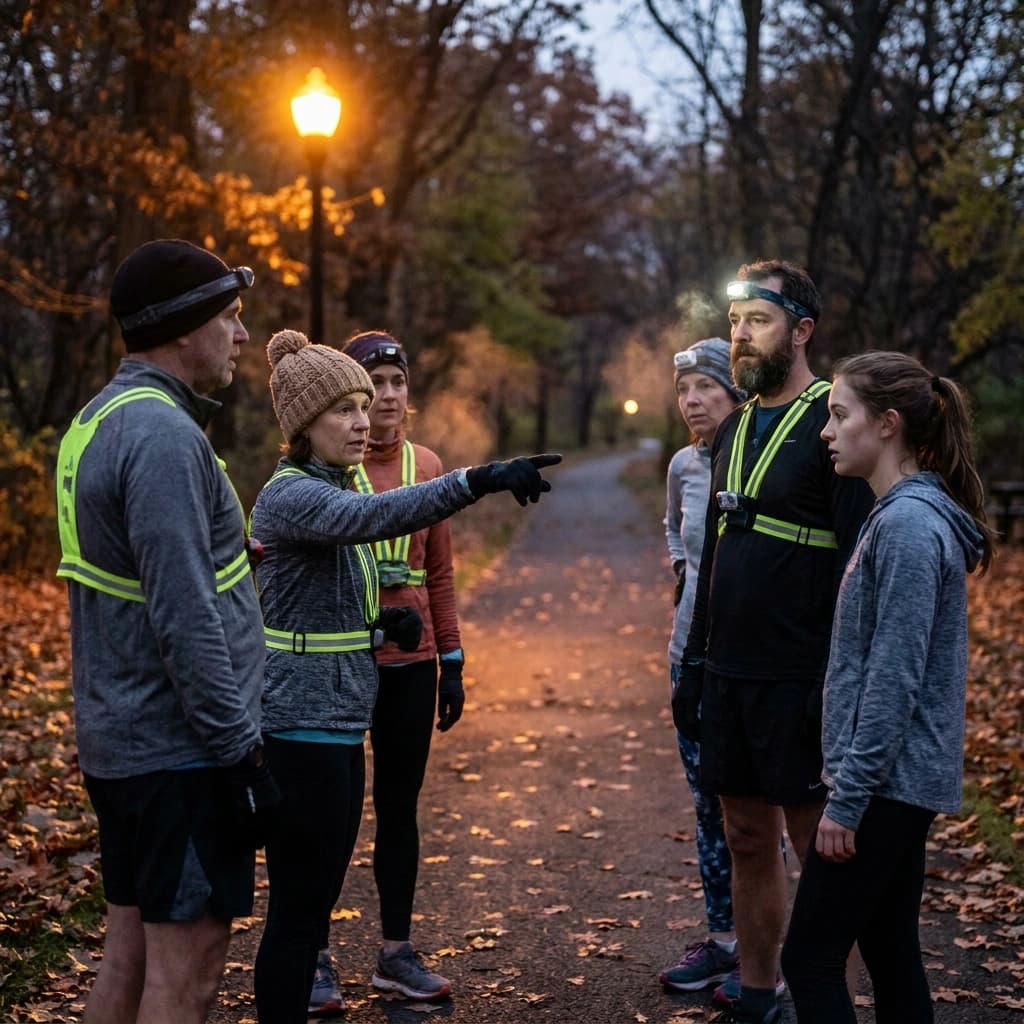
The members your club loses this fall will not be lost to winter. They will be lost in the three weeks before it, when a Tuesday evening run that used to start in daylight starts finishing in the dark, and nobody says out loud what that changes.
Daylight saving time ends on Sunday, November 1, 2026. A 6pm weeknight run that steps off in full daylight this week will finish in complete dark by the first week of November. Most clubs handle this by not handling it. The route stays whatever it was in July, the pace groups quietly thin out, and the founder tells anyone who asks that it is fine, just bring a light.
That gap is what costs you people, and the people it costs you are almost always the newest ones.
How do you keep a running club safe and full once runs go dark?
Decide the dark season rules in September, before the light goes, and publish them in one place. A club that settles its route, its visibility standard, its no drop promise, and its meeting point once, then holds the same weeknight slot all winter, keeps the members it would otherwise lose to ambiguity.
The fall drop off is a retention event, not a weather event. Members do not stop coming because it got cold. They stop because a run that used to be obvious turned into a series of small questions, and they answered those questions by staying home. Do that twice and you were never really a member.
This is worth taking seriously this year in particular. Strava's Year in Sport 2025 release, published in December 2025, reported that running clubs on its platform grew 3.5 times year over year, club-organized events rose 1.5 times, and the platform reached 1 million total clubs across all sports. A lot of clubs are about to run their first dark season with a roster far bigger than the habits they built in the spring. The number of people you can lose quietly is larger than it was last year.
Why does club attendance fall when the evenings do?
Picture the actual decision. It is 5:30 on a Tuesday in late October, and a member who joined in August is deciding whether to get in the car. They are not asking whether they are fit enough. They are asking three much smaller questions.
Where do I park now that the lot is dark. Will anyone be running my pace tonight. Will I end up alone on an unlit stretch at mile four.
Any one of those on its own is survivable. A committed member fills the gap with a guess and shows up anyway. The problem is that all three get fuzzy at the same time the light does, and for someone with six weeks of club history and no close friends in the group yet, three unanswered questions read as a reason to skip.
Your core members will not tell you this is happening. They know where to park, they know which group is theirs, and they will run in anything. The drop is concentrated exactly where growing your club is hardest, in the newest cohort, and it shows up in your numbers a month after the cause.
What the pedestrian safety data actually says for group runs
The stakes here are documented, and they are worth stating plainly to your members rather than implying.
More than three quarters of US pedestrian fatalities occur after dark, according to the Governors Highway Safety Association. Drivers struck and killed 7,148 people walking in 2024, down 4.3 percent from 2023, in figures GHSA published on July 10, 2025. There is also genuine good news in the trend: GHSA preliminary data published on March 25, 2026 counted 3,024 pedestrian deaths in the first six months of 2025, down 10.9 percent year over year, the largest decline in the 15 years the association has tracked it.
For an organizer, the useful translation is not a gear review. It is a scheduling decision. Darkness is the single largest risk multiplier in that data, which is why the dark season route gets chosen once, in daylight, by a leader who has actually run it, and never improvised in a parking lot at 6pm by whoever showed up first.
The same logic applies to visibility. A club standard that everyone knows beats a member by member debate about headlamps and vests. You are not recommending products. You are saying what the club expects, in the same words, every week, so that a new member reading your event page on a Monday night knows exactly what to bring on Tuesday. Ambiguity is the thing you are removing, and it happens to make the run safer as a side effect.
The dark season route, decided once in September
You can apply the criteria this week, before you need them. A good winter route has continuous lighting rather than one lit section and a long gap, a surface you can actually see, and as few road crossings as you can manage.
Prefer a loop over an out and back. This matters operationally, not just aesthetically. A loop lets faster groups pass the start, which means a leader gets eyes on nearly everyone at least once, and it means nobody is ever the last person alone on a stretch that the rest of the club finished twenty minutes ago.
Most clubs hit the same constraint here. The beautiful summer route, the one along the greenbelt with the water at the turnaround, is frequently the worst possible winter route. Say that out loud when you announce the change, and give the reason. A route swap that arrives with an explanation reads as the club taking care of people. The same swap announced with no reason reads as a downgrade, and downgrades cost you attendance too.
Pace groups and sweeps, so nobody finishes alone
One rule does more work than everything else in this post. Every group has a named leader and a named sweep, and the sweep is an assigned role, not a volunteer moment in the parking lot.
If your club already runs a no drop policy, the dark season is when it stops being a nice value statement and starts being the actual product. In daylight, a runner who gets dropped is inconvenienced and mildly embarrassed. In the dark, on an unlit road, that same runner is genuinely alone, and that is the reason they never come back. Same policy, completely different consequence.
You also need to know who is out there. That does not require a clipboard or a roll call that makes adults feel like ninth graders. It requires RSVPs in advance so leaders know roughly how many groups and sweeps the night needs, and a quick informal count at the finish so somebody notices if a name is missing.
This is where the default tool stack quietly fails organizers. A club feed tells you who ran, after the fact. That is a nice record and a useless planning input. On a dark Tuesday, the only number that matters is how many people intend to show up, because that is what tells you whether you need two sweeps or four, and you need it at 4pm, not at 8.
Say it the same way every week
The most common failure is not the route or the roles. It is that the dark season rules live in the founder's head and get restated slightly differently in three places.
The event listing says 6pm. The group chat says meet at 5:50 because it is dark now. Instagram still has the summer meeting point pinned. A member who joined last month finds two of those three, notices they contradict each other, decides they will catch the next one, and never quite does. Nobody did anything wrong, and you still lost them.
Fix it with one published place for the standing details and a short reminder on the day. The standing details are the ones that should not change all winter: the night, the time, the meeting point, the route, the groups, and what the club expects you to wear. The reminder is one line the day of, and its only job is to say the run is on.
Most clubs are stitching that across Strava, a group chat, an email list, and Instagram stories, and every extra surface is another place for the winter rules to drift out of sync. This is the part RunLink is built to collapse. The club page, the event with its route, RSVPs, and member messaging live in the same place, so the dark season rules get published once and every member sees the same version of them, including the person who joined yesterday and has not been added to the group chat yet.
A September checklist for the dark season
None of this requires software. It requires deciding these things before the first genuinely dark run instead of during it.
- Pick the winter route, and run it yourself at the actual hour before you announce it.
- Name a leader and a sweep for every pace group, in advance, as roles with names attached.
- Write down the visibility standard in one sentence, and use that same sentence every week.
- Confirm the meeting point and where people park when the lot is dark, since these are often not the same as in July.
- Start asking for RSVPs, so leaders know how many groups the night actually needs.
- Announce the route change with its reason, before it happens rather than at the trailhead.
- Decide, out loud, that you are holding the same night and the same time all winter.
That last one is the retention strategy, and it is the one clubs abandon first. Same night, same time, all winter, even the weeks it is twelve people instead of forty. Consistency is what lets a marginal member become a core member, and consistency is exactly what the dark months erode if you let the schedule float.
The clubs that come out of February with their fall cohort intact are almost never the ones with the best route or the brightest headlamps. They are the ones where showing up never required a guess.
If you would rather your club's winter rules lived in one place instead of four, RunLink gives you the club page, events with routes, RSVPs, and messaging in a single app, and club setup is free.
Run your club in one app
RunLink gives a running club a public club page, events with a mapped route and RSVPs, a roster with roles, and club chat in one place. The iOS app is free to download.
Related Posts
How to Choose a Running Club Meeting Spot People Return To
How to choose a running club meeting spot: parking, restrooms, light, a landmark nobody can miss, and the one rule for changing it without losing people.
Running Club Holiday Events: Plan December in October
Running club holiday events go better when the founder plans in October: which December Saturdays to use, three events worth running, and the January handoff.
Running Club Survey Questions That Tell You Why People Leave
Running club survey questions that surface why members drift away: what to ask, when to send it, how to keep it short, and what to do with the answers.