
How to Choose a Running Club Meeting Spot People Return To
How to choose a running club meeting spot: parking, restrooms, light, a landmark nobody can miss, and the one rule for changing it without losing people.
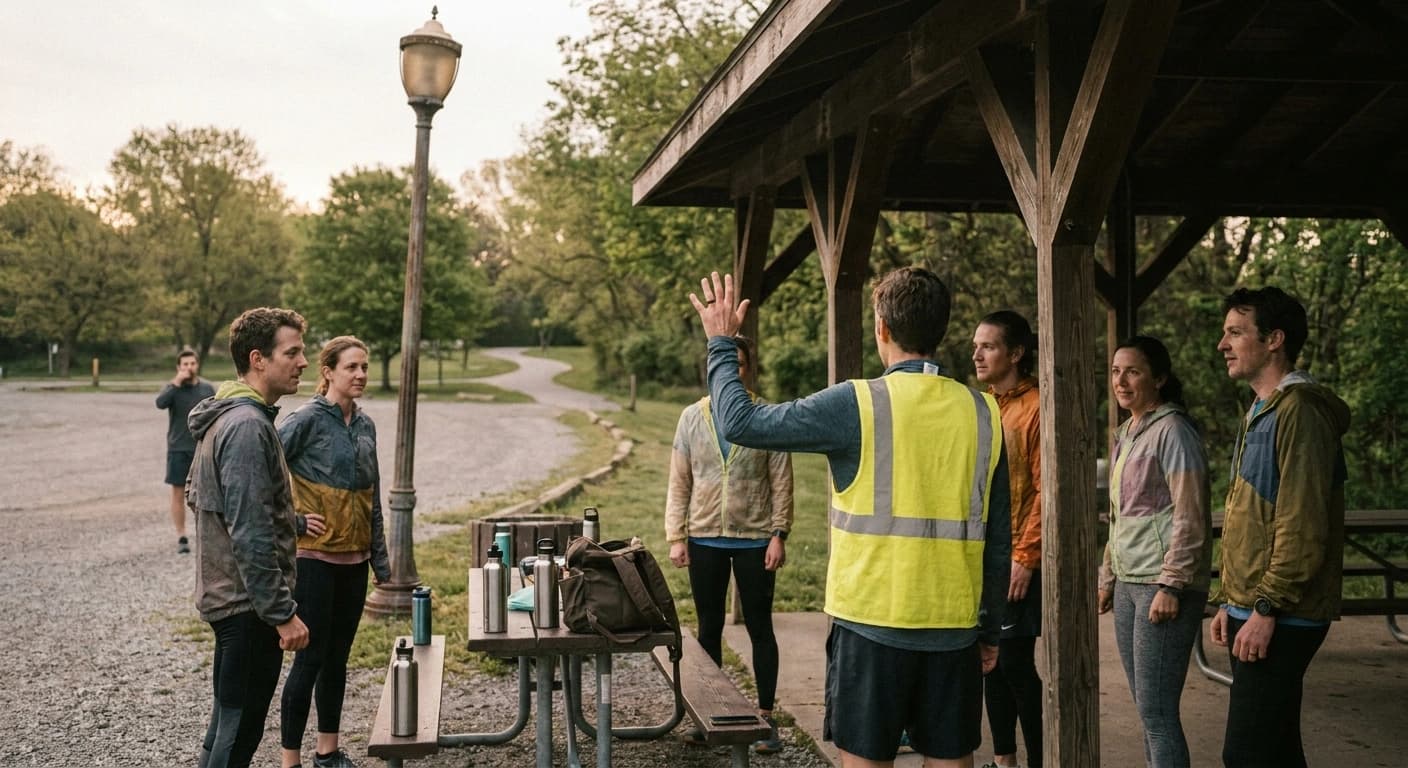
A good running club meeting spot is one a first-timer can find alone in the dark, park or walk to, use a restroom at, and stand around at with thirty other people without blocking anyone, with somewhere to go afterward within a short walk. Pick it once per season, score it against a short checklist, and describe it the same way everywhere you mention it.
Most founders pick the first meeting spot by accident. By month three that spot is quietly deciding who comes back, and nobody tells you why they stopped.
The meeting spot is the first thing a new runner experiences, before the run and before anyone says hello. If they circle the block twice looking for parking, cannot find the group, or have nowhere to leave a key, the run never had a chance. This guide is about treating that choice as an operating decision, the same way you would treat the day and time. It is part of managing a running club well, and it works with or without any app.
What makes a good running club meeting spot?
Think about the person you most want to keep: someone who has never met anyone in the club, arriving alone, a little early, slightly nervous. Every criterion below is really a question about that person.
Can they find you without texting anyone? Can they get there without circling? Is there a restroom before a 6:00 a.m. start? Can they stand somewhere safe while they wait? Will they see a group, or a scattered handful of strangers who might be anyone?
The regulars stopped noticing the spot long ago. The newcomer knows none of it, so the spot has to be legible to a stranger, not just convenient for the founder.
Which checklist should a founder score a meeting spot against?
Score each candidate spot from 1 to 10 on each line, at the hour your club actually runs. A spot that scores well at noon on a Sunday can score terribly at 6:00 a.m. in November.
- Findability. A named landmark a stranger can spot: a storefront, a statue, a specific pavilion, the trailhead sign. "The north side of the park" is not a landmark. "The covered pavilion next to the tennis courts, by the tall lamp post" is.
- Parking and transit. Enough free or cheap parking for your typical turnout plus a few newcomers, and ideally a bus stop or bike rack within a short walk. Paid street parking with a two-hour limit punishes your post-run social.
- Restrooms and water. Open at your start time, not just during business hours. This is the line that most often separates a park that looks perfect from one that works.
- Light and safety at run time. Lit parking, a lit start, and a first stretch of route on a sidewalk or path rather than a road shoulder. Score the finish too, because people leave alone.
- Standing room. Space for the whole group plus bags, without blocking a doorway, a bike lane or a business entrance. A crowd on a narrow sidewalk annoys neighbors and scatters the group.
- Cell signal. Enough to pull up the route, message a lost newcomer, or call for help.
- The post-run spot. A cafe, brewery, taco truck or patch of grass within a five-minute walk. The social is where strangers become regulars, so a long drive to it costs you more than it looks.
- A host who wants you there. If the spot belongs to a business, does the owner actually welcome a pack of sweaty runners, or tolerate you until the first complaint?
You do not need a perfect score. You need to know which line is weak so you can fix it on purpose, like a portable flag for findability or a shorter first loop if the start is dark.
Store, park, trailhead or cafe: which meeting spot fits your club?
Most clubs end up choosing between four kinds of spot, and each one trades something.
A running store. You get shelter, usually a restroom, a host who wants runners around, and a natural place for gear talk. The trade-offs are store hours, a limited parking lot, and a vibe that can tip toward a sales floor if the relationship is not clear. If you are weighing this option, our guide to partnering with a local running store covers what to agree on before the first run.
A park or pavilion. Free, roomy, and easy to grow into, with paths that make for flexible routes. The weak lines are almost always restrooms and light after dark, and a big park makes "meet at the park" useless unless you name a specific spot inside it.
A trailhead. Great routes, but the worst parking, the weakest signal, and the hardest place for a newcomer to find in low light. It suits a weekend long run better than a weeknight anchor.
A cafe or brewery. The social is built in and the host has a reason to want you there. The friction is mornings and sweat: some places open too late, and some owners cool on thirty damp runners filling the patio.
Many clubs land on two spots: a weeknight anchor at a lit, central location with a post-run option, and a weekend long run somewhere with better routes. That works, as long as each spot is fixed to its day and never swapped casually.
How do you set up the spot so first-timers actually find the group?
Choosing the spot is half the job. The other half is making it impossible to miss.
Write one exact sentence and use it everywhere. It names the landmark, the side of the street or lot, what to look for, and when the group leaves. For example: "We meet at the covered pavilion by the tennis courts on the east side of the park. Look for the orange flag. We leave at 6:00 sharp." That sentence goes on your club page, your events, your chat and your social posts, word for word. Treat it like the day and time of the run: fixed wording, repeated without edits.
Give the group a visible marker. A flag, a club color, or the run leader standing at the landmark ten minutes early, so a newcomer scanning a lot at dawn knows which cluster is the group.
Name a greeter. One person whose only job for the first ten minutes is to spot whoever is standing alone and walk over. If you are still planning opening day, these ideas for your first run club meeting go deeper on that welcome.
Plan for the dark season. When the clocks change, the start and the finish both get darker, and the finish matters more because people leave on their own. Re-score your spot for light every fall. Our guide to night run safety once the clocks change covers routes and visibility in detail.
When should a running club change its meeting spot, and how?
People build their week around a meeting spot and stop reading the details once they know it. That is why moving it carelessly costs you members.
Change it only for a reason you can say in one sentence: the store closed, the group outgrew the sidewalk, the park lost its lights for the winter. "It might be nicer over there" is not a reason.
Then follow a simple rule:
- Decide once per season. Fall and spring are natural points. Do not move week to week.
- Announce it for two weeks before the move, in the same words everywhere, with the new one-sentence description.
- Never move it the week before the club's goal race. Race week is already full of logistics and nerves. A new start point is one more thing to get wrong.
- Keep the old spot in the announcement for a month. "We now meet at X (we used to meet at Y)." Someone who has been away for three weeks will still drive to Y.
You will not get a perfect read on whether the move cost you anyone. You will notice the familiar faces that stop showing up, and that is the signal to reach out personally and ask.
Where RunLink fits
RunLink gives a club one place for the details that answer "where exactly do you meet." Put the meeting spot and start time on the event so everyone who RSVPs sees exactly where to show up. Draw the route by dropping waypoints on a map and attach it to the event; the route start pins to the event location, so members see where the run begins and where it goes. Answer the inevitable "which side of the park?" question once in the club group chat instead of in a dozen separate messages. And a runner who finds your public club page can see where and when the club meets before they ever show up.
If you are still at the very beginning, our guide to getting a running club off the ground covers the decisions that come before the meeting spot.
FAQ
Should a running club have one meeting spot or rotate between several? One fixed spot per recurring run is the default. Rotating spots work for occasional special runs, but a weekly anchor run that moves around loses newcomers, because they cannot build a habit around a moving target.
What if the only good spot has no parking? Lean on the other options: a nearby lot a few minutes away, transit, bike racks, carpools from a second point. Say the parking plan in your one-sentence description so newcomers do not discover the problem at 5:55 a.m.
How do you tell people the meeting spot moved? Two weeks of the same announcement everywhere, with the old spot named alongside the new one for a month. If you can, put a person at the old spot for the first week.
Make the spot a decision, not an accident
Score the spot at your real run time, fix the weak line on purpose, describe it in one sentence everywhere, and move it only for a reason and on a schedule.
If you run a club and want one place for your club page, events with RSVP and a drawn route, your roster and your club chat, Claim Your Club on RunLink. The iOS app is free to download for your members.
Run your club in one app
RunLink gives a running club a public club page, events with a mapped route and RSVPs, a roster with roles, and club chat in one place. The iOS app is free to download.
Related Posts
Running Club Roster Management: One Source of Truth Instead of Five
Running club roster management is broken when your member list lives in Strava, Sheets, Eventbrite, WhatsApp, and Mailchimp. Here is how to fix it.
Running Club RSVP System: Stop Chasing Headcounts Before Every Group Run
A real running club RSVP system replaces the WhatsApp poll, the Google Form, the Strava event, and the spreadsheet. Here is what it should actually do.
Running Club Attendance Tracker: Why You Need One the Moment Your Club Crosses 25 Members
A running club attendance tracker stops the headcount guesswork, reveals who is drifting, and turns Saturday mornings into data your club can actually use.